










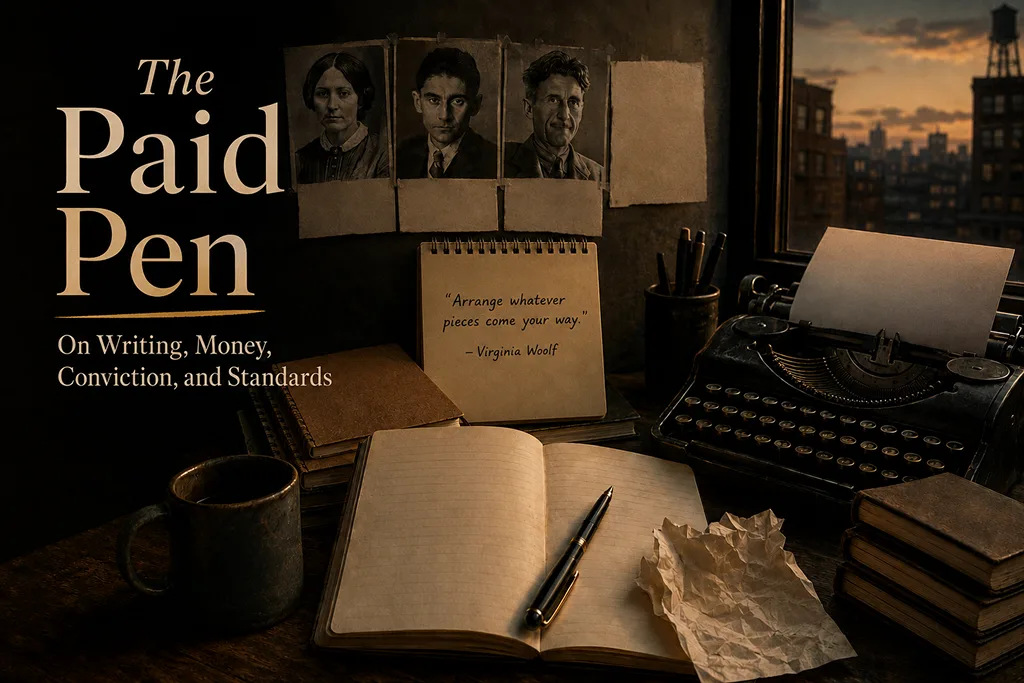









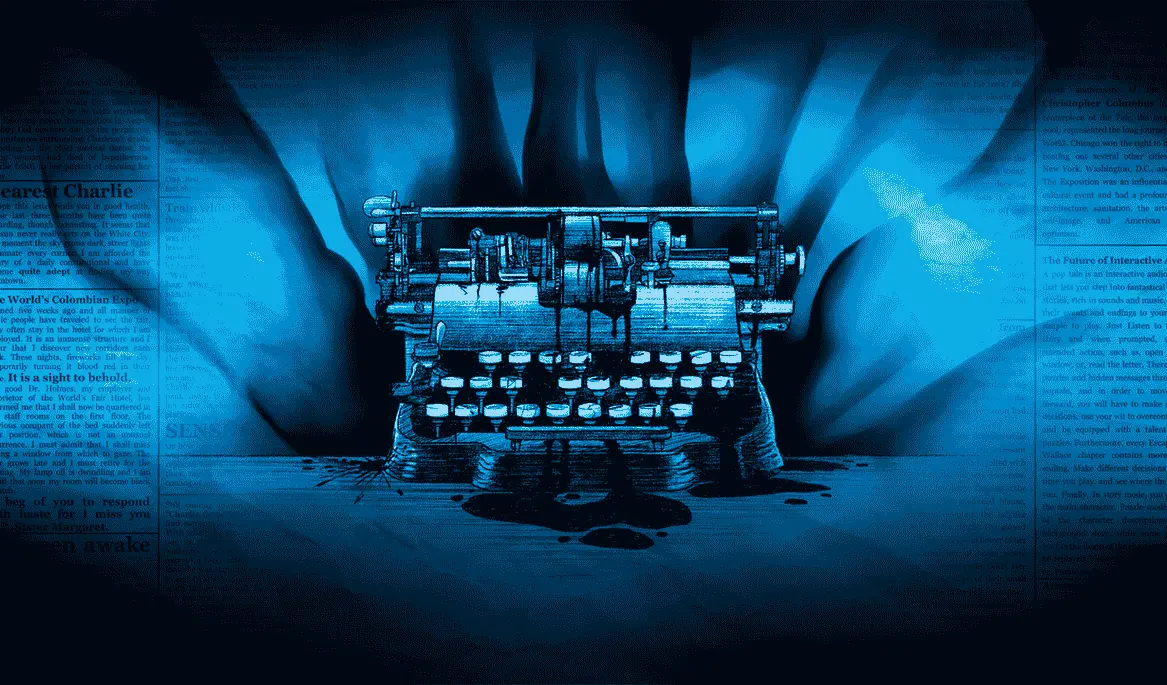



Woolf told us to arrange whatever pieces come our way. Not to wait for the right circumstances or the market to want what you have.
“Arrange whatever pieces come your way.” Virginia Woolf said that.
It sounds like advice about craft, and it is, but read it again slowly. It’s also something more uncomfortable. It is an agency statement: about the writer’s responsibility to work with what life hands them, not to wait for ideal conditions, not to perform for whoever is watching, but to arrange. To shape. To make something intentional out of whatever raw material the world provides.
Woolf believed that a writer needed financial independence to do this well. Without money and a room of one’s own, the mind cannot settle into the kind of deep, unhurried thinking that writing demands. I, for one, don’t believe she was being romantic. Financial pressure is not just a practical inconvenience; it’s a cognitive one. A writer wondering how rent will be paid next month is not fully present on the page. Part of them is already elsewhere.
She was right, but she only got half of the argument.
Here is what the history of literature keeps insisting on, quietly, in case we are listening: some of the greatest work ever written was made by people with no money, no audience, and no reason to believe anyone would ever care.
Emily Brontë published one novel when she was thirty years old. She published it under a man’s name because she knew the world would not take a woman seriously, and she died a year later, with no way of knowing that Wuthering Heights would one day be considered one of the finest works in the English language. The critics who reviewed it called it coarse, savage, and inappropriate. The work survived everything: the poverty, the dismissal, the wrong century, even the author’s early death.
Franz Kafka held an office job he found suffocating and wrote in the hours it left him. He asked his friend to burn everything when he died. George Orwell wrote his last and greatest novel on a remote Scottish island, his body failing, knowing the cold would probably kill him, writing it anyway. None of these writers was comfortable. None of them had what Woolf prescribed. And yet they produced great works.
What they had instead was something harder to name and harder to teach: strength of character when no one was watching. They were not writing for the room, because there was no room. No advance, no algorithm, no trending topic, no publishing house holding a deadline over their heads. They wrote as if the work itself was the only court they answered to. And that, not the money, comfort, or acclaim, is what made the work last.
Now look at where we are.
The publishing industry produced roughly four million books in the United States alone in 2025. Four million. A single self-publishing platform had to implement a limit of three books per author per day because the volume had become unmanageable.
Artificial intelligence can generate a draft in hours. Content mills churn out articles calibrated to what the algorithm rewards this week, knowing that next week the algorithm may want something else entirely, and the cycle will begin again.
This is what happens when the first question a writer asks is not “what do I have to say?” but “what does the market want?” That question sets a ceiling before a single word is written. It determines the research, the risk-taking, the willingness to follow an uncomfortable idea all the way to where it leads rather than turning back toward safer, more sellable ground.
Motive is not a minor detail in the writing process. Motive is the architecture. Everything else is built inside it.
Consider the four kinds of writers working today, because the pressure lands differently on each.
The full-time writer—the one whose livelihood depends entirely on the pen—is the most exposed. Not because they lack talent, but because survival is loud and integrity is quiet. Early in a career, the temptation to write toward what pays is not a weakness. It is hunger. But hunger, if it goes unnamed, becomes habit. And habit, over time, becomes a voice that no longer sounds entirely like the person it belongs to.
Some full-timers resist this. The ones who do have usually decided, consciously and early, what they will not trade. Those who haven’t often don’t notice the drift until the work starts to feel hollow even to them.
The hybrid writer and the platform writer — the Substack essayist, the creative with multiple income streams — who tend to oscillate. When the passion arrives like a fevered dream, when the idea has been lived with, turned over, argued against, and finally set down, the work is alive. You can feel it. But when there are quotas to meet, when the newsletter must go out on Thursday regardless of whether Thursday has anything worth saying, the other version shows up; distracted and thin. The reader notices, even if they cannot name what is missing.
Then there is the side writer—the one whose pen does not have to feed anyone. The retired teacher writes at dawn. The young woman whose family’s stability allows her to afford to be honest. The rebel, any age, any income, who has simply made peace with the possibility that the work may not pay, and has chosen to write anyway, and because of that choice writes with a freedom the others have to fight for every single day.
But do not romanticise the side writer either. Comfort alone has never produced great work. What produces great work is conviction; the internal decision that the work answers to something deeper than approval or income. That conviction can live inside a full-timer with enough self-awareness. It can survive poverty, as Orwell proved. It can survive obscurity, as Brontë proved. What it cannot survive is the quiet replacement of the writer’s own question with someone else’s.
Now, let’s bring it home because in Nigeria, this is not an abstract literary debate. It is immediate.
The literary community here operates within a survival economy, and that pressure has done something rarely said aloud. It has slowly trained readers to expect less.
When the work is consistently optimised for what sells quickly, for what trends, for what can be produced at volume with minimum friction, the standard does not announce its own decline. Readers absorb that drift. They begin to internalise a lower ceiling for what writing can be, and do, and ask of them.
This is not an argument against being paid. Writers deserve to eat. The problem is not money — Woolf was right about that much. The problem is the order of operations. Money that follows conviction is different from money that precedes it. When the cheque is the reason you sat down, it is also the limit of what you’ll discover when you do.

Photo credit: Unsplash
You can’t outsource thinking.
And then there is the AI question, which is really the same question wearing different clothes.
There is nothing wrong with a tool. Writers have always used tools: research, editors, conversation, and revision. The line is not drawn at assistance. It is drawn at substitution.
When a writer types a topic into a prompt and accepts what comes back as their own thinking, something has been skipped that cannot be recovered by editing. The pressure applied to an idea, the research, the argument with yourself, the contrast and comparison, the conversation with another mind, the three versions that were discarded before the real one emerges, that pressure is not inefficiency. It is the work.
It is where the soul of the piece is formed. AI can help you punctuate your thinking. It cannot think for you. And readers, even readers who could not explain why, can feel the difference between a piece that went through something and a piece that was generated. One has a spine. The other has the shape of a spine.
Woolf told us to arrange whatever pieces come our way. Not to wait for the right circumstances or the market to want what you have. To arrange. To take agency over the material of your own thinking and make something that could not have existed without you specifically, your friction, your obsessions, your willingness to stay in the room with the hard question until it opens.
The greatest writers were not always the most comfortable, the most celebrated, or the most paid. They were the ones who kept writing as if the work itself was watching. As if the page had standards it was accountable to, whether anyone else ever knew or not. Their greater commitment was to whatever piece they wrote.
You already know which kind of writer you are. The more honest question, the one worth sitting with, is whether you are becoming more of that person, or less.
Ask yourself: What were you asking when you sat down? What are you actually making?
Hi I'm Tega, I am a microbiologist with a lifelong passion for reading, I fell in love with books as child (where I was briefly obsessed with Enid Blyton, lol) reading is simply my escape and hobby and sometimes doubles as therapy for me . My favorite genres are African lit, historical fiction, memoirs/biographies and fantasy. I do beta reading and post book reviews which you can check out on my Instagram @ te_ga_o.
October 28, 2025 .
Lists, Marvel, MCU, Opinions
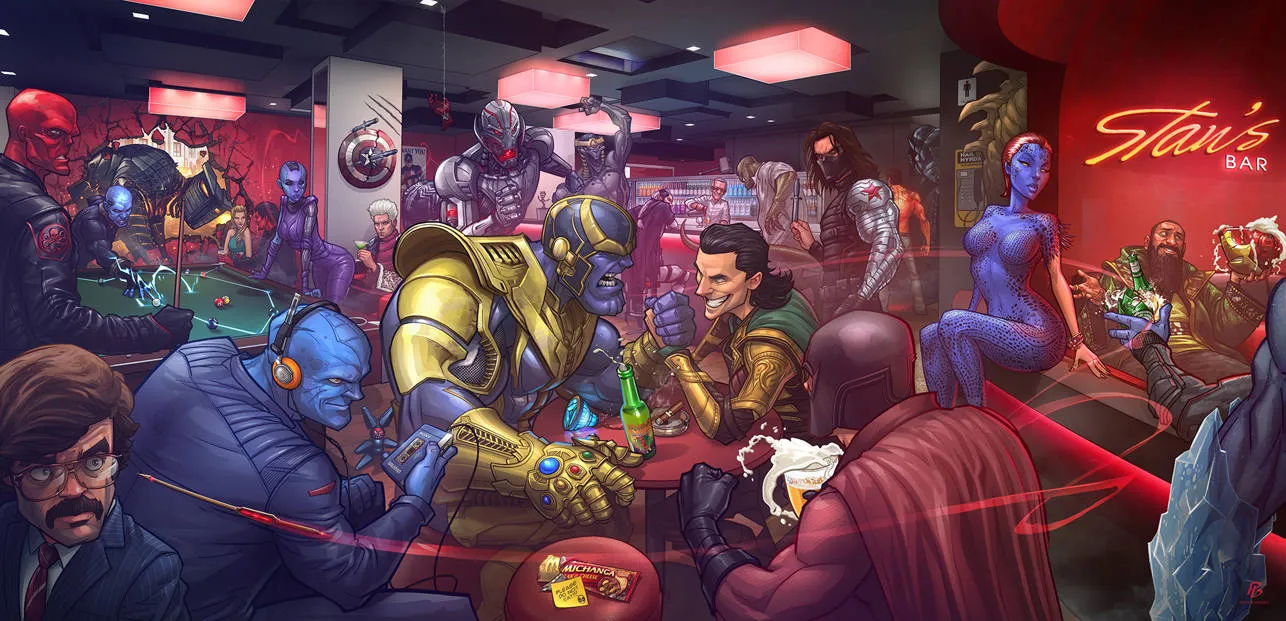
Let’s go through a list of the top 7 strongest Marvel villains, from the wickedly powerful to the absolutely unstoppable. ...
READ MORE
June 25, 2026 .
Lists, Opinions
If Game of Thrones taught us anything, it’s that the characters we hate the most tend to outlive everyone else.
READ MORE
July 20, 2025 .
Animation, Lists
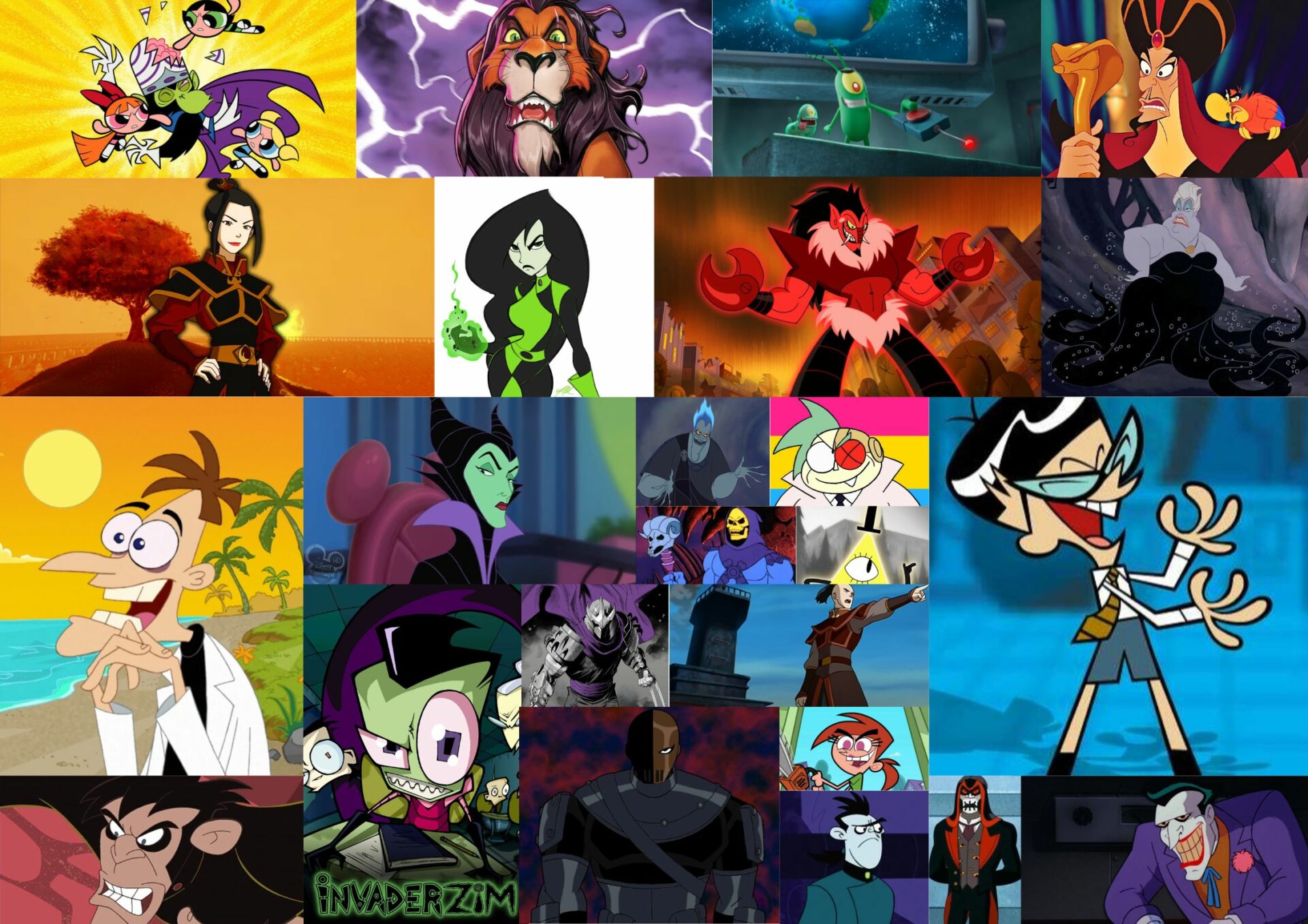
Our list rounds up the top 30 cartoon characters that were villains, each one more wonderfully wicked than the last.
READ MORE
February 26, 2026 .
Cartoons, Lists
There are some outright funny cartoon characters who exist solely to crack you up, loud, hard, and with zero apology.
READ MORE
May 6, 2026 .
Lists, MCU
Spider-Man is one of the many superheroes from the Marvel Universe whose stories shaped many childhoods. Who is your strongest Sp...
READ MORE
October 28, 2025 .
Debates, Lists, Marvel, MCU
Every Marvel hero brings something to the table. But if we had to pick the top 8 most popular Marvel superheroes, who would make t...
READ MORE
November 27, 2025 .
Lists, Mythology
While this isn’t an exhaustive list, it comprises some of the most popular mythical creatures from around the world.
READ MORE
Get our magazine for free!